

- Version
- 2.1.4
- Studio or maker
- PixelCut
- Languages
- English
- Activation
- K'ed by TNT team
- Runs on macOS
- macOS 11.5 or later
- Chip type
- Intel 64-bit
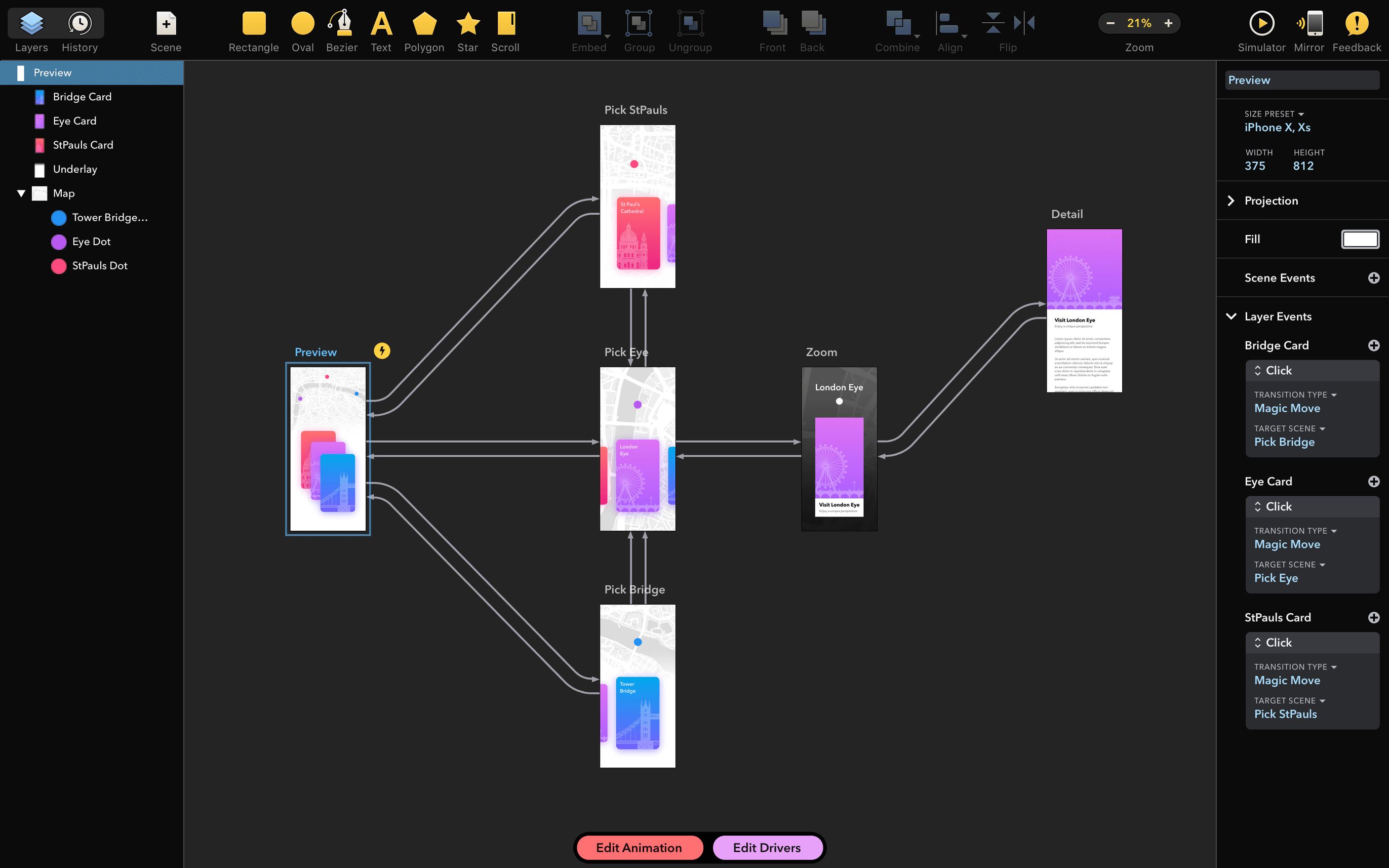
If you already use PixelCut's PaintCode for generating resolution-independent graphics, Drama will feel like a natural next step. Where PaintCode exports static assets, Drama lets you sketch interactions and transitions before you write any front-end code. I gave it a run with a simple mobile onboarding flow, something I usually map out in a general-purpose vector tool.
After installing the x86 64-bit app on an Intel Mac running macOS 11.5, I opened it and started placing frames. The canvas feels responsive, and the inspector panel groups properties in a way that doesn't bury the important controls. For the onboarding flow I added a button state change and a swipe gesture. The animation timeline is straightforward: set a start keyframe, move the element, set an end keyframe, and preview. It took maybe ten minutes to get a three-screen prototype that I could play back.
The English-only interface kept things simple, and the release notes mention that a crash caused by specific installed fonts was fixed in version 2.1.4. If you work with large font collections, that fix matters. For a teacher running a game club, Drama is not a game tool, but I can see it being used in a design elective to show students how app interfaces are planned before coding begins.
Prototyping a weather app interface for a design class
I sat down with Drama to prototype a small weather app interface, something I might show a design club student as an example of planning before coding. I started by creating a new document and adding a phone-sized frame from the built-in presets. The canvas stayed quiet and responsive as I dragged in a few rectangles for the header and forecast cards.
Next I selected one of the cards and switched to the animation panel. I set a starting position off the right edge, then moved the card into its final place and set a second keyframe. The timeline showed both keyframes with a default easing curve. I adjusted the duration by dragging the second keyframe slightly to the right. A quick press of the preview button played the animation: the card slid in from the side with a natural ease.
For the second screen I added a tap interaction. I selected a button shape, then drew a connection line to the next frame. Drama drew the interaction arrow automatically. I set the trigger to "tap" and the action to "navigate to frame 2." When I previewed again, clicking the button on frame one switched smoothly to frame two. No code, no export, just a visual prototype that I could hand to a student as a reference.
The session ended with a short export. I chose PNG sequence for each frame, which gave me individual images I could drop into a presentation. The whole workflow, from blank canvas to playable prototype, took about twenty minutes.
how drama compares to similar mac apps
I have used several prototyping tools over the years, and Drama sits in a particular spot. Compared to Sketch, Drama is more focused on behavior and less on static layout polish. Sketch excels at pixel-perfect design systems, but you need a separate plugin or export step to get animation. Drama keeps animation and interaction inside the same file.
Principle is another app I have tried. It also does interaction prototyping with a timeline, but its vector tools are lighter. Drama gives you more control over shapes and gradients without leaving the prototyping environment. For someone like me who prefers to stay in one app from drawing to preview, Drama feels less fragmented.
Flinto, which many UI designers use, handles scrollable content well but its animation model is limited to predefined transitions. Drama's keyframe approach offers more flexibility for custom motion. If you want to animate a logo bouncing or a button morphing into a card, Drama's timeline lets you set exactly where and when each change happens.
Built for UI designers, design teachers, and solo developers
UI designers who build interactive prototypes will use Drama daily. But I think the app also suits people who teach design or work on small teams without a dedicated animator. A solo developer designing a mobile app can sketch the interface, animate the transitions, and share a playable prototype without opening a second tool.
For educators, Drama is a clean introduction to interaction design. Students can see cause and effect: a tap here leads to a motion there. The English interface is straightforward enough that a high school student with basic design vocabulary can follow along. In my own school, I could assign a short project where students prototype a simple app screen and present the animated version to the class.
People who manage large font collections will appreciate the crash fix in version 2.1.4. That detail matters if you install hundreds of typefaces for design work. And anyone who already uses PixelCut's PaintCode will find Drama's interface familiar, making the switch to prototyping a natural extension of their existing workflow.
- A crash on start caused by specific installed fonts was fixed.
- macOS 11.5 or later
- Intel processor (x86 64-bit)
- Interface language: English
Questions I keep getting
Does Drama run on Apple Silicon Macs?
No, it is an x86 64-bit app and requires an Intel processor.
What version is listed in the catalog?
Version 2.1.4, which includes a fix for a start-up crash related to certain installed fonts.
How to install
- Mount the disk image and run the Open Gatekeeper-friendly file.
- Press Enter in the Terminal window to bypass Gatekeeper.
- Drag the app to your Applications folder.
- Open the app after the copy finishes.
Similar apps




Sign in or join the club to leave a comment.
Nobody has commented yet.