- Version
- 2.4.0 [MAS]
- Studio or maker
- XiuXia Yang
- Languages
- Russian, English, German, Spanish, Italian, Chinese (Traditional), Chinese (Simplified), French, Japanese
- Activation
- K'ed by TNT team
- Runs on macOS
- macOS 10.13 or later
- Chip type
- Apple Silicon, Intel 64-bit
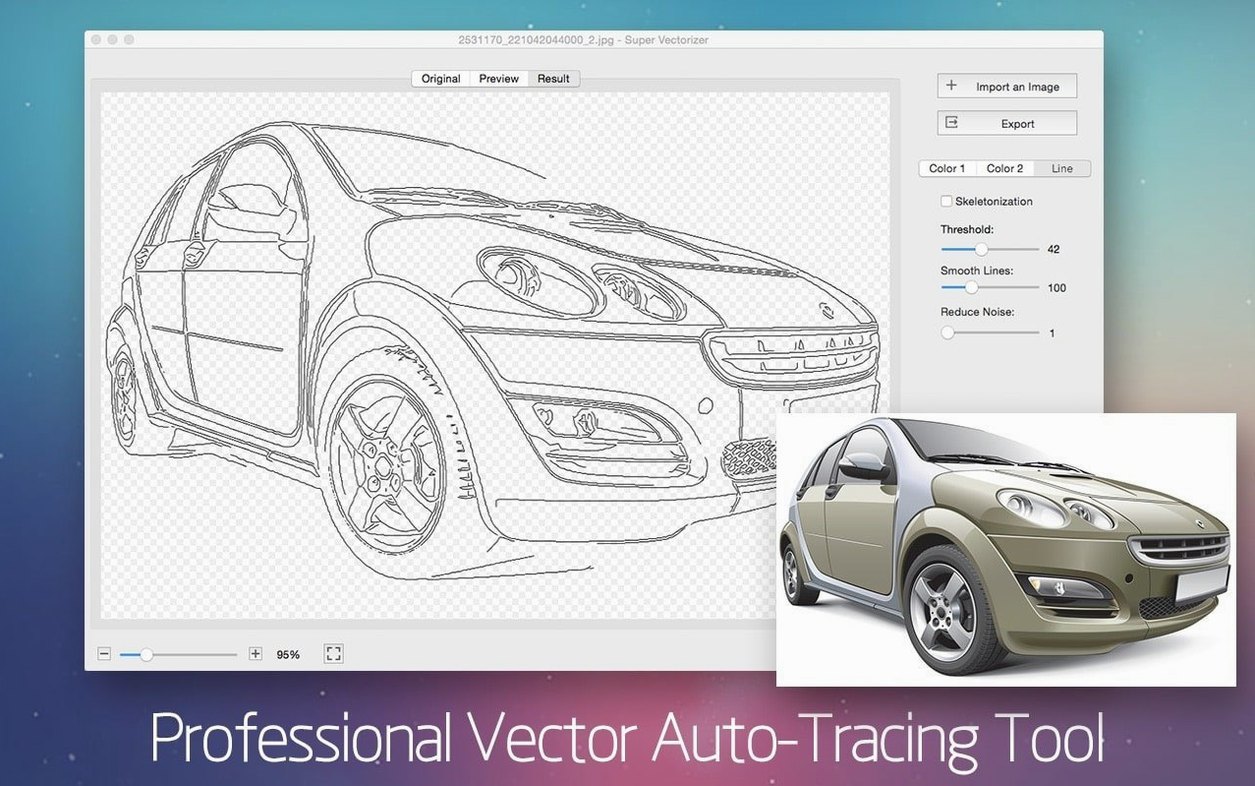
The live preview window shows the vectorization effect as you adjust settings, so you see exactly how a pencil drawing or logo trace will look before you commit. Super Vectorizer Pro 2.3.3 keeps the same core workflow: import a bitmap, choose up to 64 colors, and let the app generate clean vector lines. The output options remain AI, SVG, DXF, and PDF, with transparent background support for overlays.
Reliable trace engine unchanged for scans and logos
Version 2.3.3 does not add new features. What you get is the same reliable trace engine that handles scans, photographs, and low-resolution logos. The interface languages still include English, German, French, Spanish, Italian, Japanese, and Chinese. System requirements stay at OS X 10.10 or later, running on both Intel and Apple Silicon Macs without separate builds.
No changes means nothing new to learn for existing users
No changes in this release mean the app works exactly as it did before. For teachers and hobbyists who already know the tool, there is nothing new to learn. New users get a straightforward, no-surprises vectorizer with real-time feedback and a clean set of export formats.
Skeletonization function reduces line art to center-line paths
Super Vectorizer Pro includes a skeletonization function, which is worth knowing about if you work with line art or handwritten sketches. It reduces shapes to thin, center-line paths rather than outlining the full area. This is useful for converting pencil drawings or scanned signatures into editable vector strokes, not filled shapes. The option is not buried, but it is easy to overlook when you are focused on color settings.
The transparent background output is another detail that saves time later. When you export a logo or a drawing that needs to sit on top of a colored page, you do not have to remove a white rectangle in Illustrator or Corel after the fact. The app handles that during conversion if you select the right export export format.
Input format support is broad: more than 70 image types. That covers not just common file formats like PNG and JPEG, but also less frequent ones that scanners or older graphics programs produce. If a student brings in an odd file from a digital camera or an old drawing tablet, the app accepts it without needing a separate converter.
Choosing too many colors overwhelms simple sketches
A common first mistake is choosing too many colors. The app supports up to 64 colors, but a pencil sketch or a simple logo rarely needs more than four or five. Beginners set the slider to maximum, expecting more detail. Instead, they get a noisy result with small scattered patches. Reducing the color count to match the original image usually gives a cleaner vector.
Another error is running the trace on a very small source image. Bitmap images that are only a few hundred pixels wide produce vectors with jagged curves. The app cannot invent detail that was not there in the original. Scaling up a small photo or low-resolution scan before importing helps the trace engine produce smoother lines.
Some new users forget that the live preview updates only while the app is actively tracing. If you change a setting and nothing happens on screen, it is because the preview needs a moment to recalculate. Clicking the apply or trace button again updates the view.
Exporting to the wrong format for the destination editor is also common. For example, exporting as AI when you plan to open the file in Corel Draw might require an extra import step. SVG and PDF are generally more portable between different vector editors on Mac.
Runs on OS X 10.10 or later, including Apple Silicon models
Super Vectorizer Pro 2.3.3 runs on OS X 10.10 or later, which covers Yosemite through current versions of macOS. It supports both 64-bit Intel Macs and Apple Silicon models with the ARM architecture. There is no separate download for each processor type; the same disk image works on both.
The interface is available in nine languages. If your classroom or studio uses German, Spanish, Italian, French, Japanese, Chinese, or Russian, the menus and settings display in your preferred language without extra configuration.
Installation involves mounting the disk image, using Gatekeeper-friendly commands in Terminal to bypass the security check, and then dragging the application into the Applications folder. After that, launching the app is all it takes to start tracing images.
- A new Region mode traces an image by splitting it along real edges and filling each region with its own color. It handles complex portraits with thousands of regions while keeping gradients and fine structure intact.
- The edge enhancement pass was rewritten: colors snap once at the boundary, and the boundary itself no longer drifts. Soft halos and white seams are gone.
- Two new controls give you finer cleanup. Simplify merges regions with similar colors, and Min Area removes tiny speckles. Both used to share a single slider.
- Ten built-in presets are now included: Portrait, Landscape, Icon, Manga, Line Art, and Text, plus Icon and Manga for Color mode.
- AI super-resolution preprocessing upscales small images and line art before tracing for cleaner edges. Exports stay at the original size. (Apple Silicon only)
- EPS format output is now supported.
- macOS 10.13 or later
- Apple Silicon or Intel 64-bit processor
Questions I keep getting
Can Super Vectorizer Pro convert pencil drawings?
Yes, it handles pencil drawings and logo images well, showing the vector result in real time as you adjust settings.
What file formats does it export?
It exports AI, SVG, DXF, and PDF files, and supports transparent background output.
How to install
- Mount the disk image and run Open Gatekeeper friendly.
- Press Enter in Terminal to bypass Gatekeeper.
- Drag the app into the Applications folder.
- Launch the app after installation.
Similar apps

Sign in or join the club to leave a comment.
Nobody has commented yet.