- Version
- 2.1
- Studio or maker
- Synapse Audio
- Languages
- English
- Activation
- k'ed by GUISEPPE
- Runs on macOS
- macOS 10.14 or later
- Chip type
- Apple Silicon, Intel 64-bit
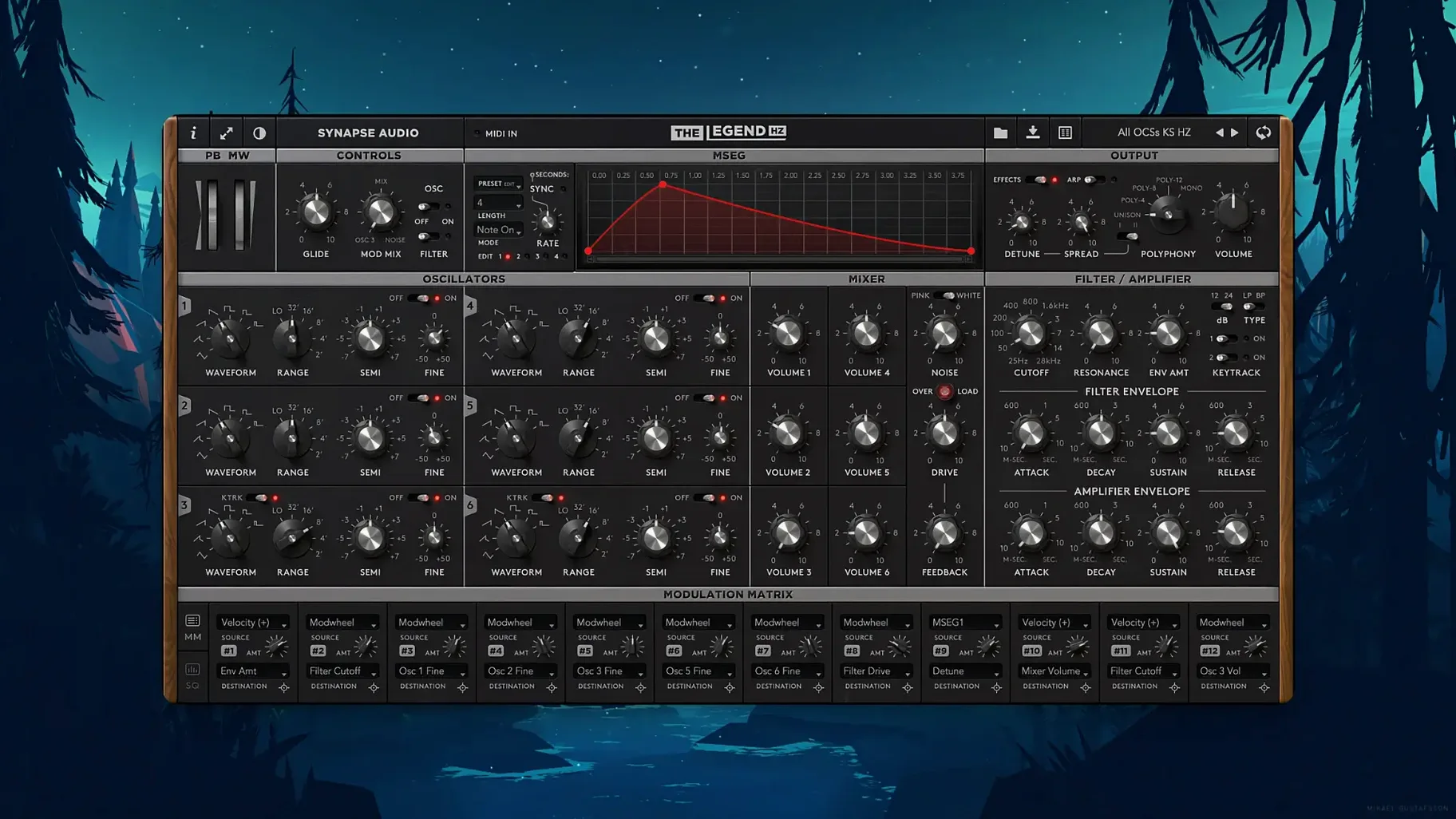
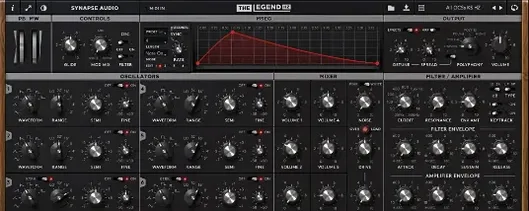
Version 2.1 of The Legend HZ, Synapse Audio’s analog-modeled synthesizer developed with Hans Zimmer, adds compressor saturation and 50 new factory presets by Kevin Schroeder. A paragraphic equalizer now lives on the back panel, and MTS-ESP microtuning support is included. The plugin remains available in VST, AAX, and Audio Unit formats for macOS 10.14 and later.
Shapes low end with the 914 Fixed Filter Bank
- Shaping the low end with the 914 Fixed Filter Bank — useful if you want to emphasize or cut material around a specific frequency range.
- Dialing in saturation per voice using the new compressor circuit, which adds warmth before the filter stage.
- Layering basses and leads from the 200 factory presets (50 new in v2.1) without starting from scratch.
Supports MPE, Native Kontrol, Intel and Apple Silicon Macs
- It supports MPE and Native Kontrol Standard, so it works with expressive controllers and NI hardware.
- The interface is English only.
- Both Intel and Apple Silicon Macs are supported under macOS 10.14 or later.
Working with The Legend HZ from scratch
I often sit down with The Legend HZ when I want a thick bass line for a student arrangement or a quick demo. My typical session starts by browsing the presets — the 250 now available, including the new ones by Kevin Schroeder. I load a preset called something like “Zimmer Bass” to hear what the six VA oscillators can do together. From there, I adjust the filter bank to cut a narrow band if the low end feels woolly. The new paragraphic equalizer on the back panel lets me notch out a problem area without leaving the plugin.
Once the tone is close, I activate the arpeggiator to turn a held chord into a rhythmic pattern. Most of my students find the sequencer section intuitive: you draw in a few steps, set the rate, and let it run while you tweak the compressor saturation. The compressor adds a bit of grit, not a drastic squash. I keep the unison mode on during the first pass, then spread voices across the 12-voice polyphony once the arrangement needs chord stabs. The MPE support means I can use a pad controller to bend individual notes in real time — useful when scoring short film exercises.
Oscillators sound cleaner than Arturia’s Mini V
The Legend HZ sits alongside other analog-modeled plugins like Arturia’s Mini V and U-he’s Repro-5. The Mini V offers a familiar layout and a larger preset library from Arturia, but its oscillators sound different — they lean cleaner in the midrange. Repro-5 goes deeper into circuit modeling and includes a built-in effects rack, but its interface is busier. What sets The Legend HZ apart for me is the direct collaboration with Hans Zimmer. The 250 factory presets here are designed for cinematic layering, not just lead and bass. The 914 Fixed Filter Bank is a specific tool I have not seen in the other two; it lets you shape the spectrum in fixed bands, which is handy when a precise boost or cut is needed in a specific frequency range. All three run on Apple Silicon, but The Legend HZ includes the MTS-ESP microtuning and MPE support that the others do not offer natively.
Point the browser to the original Legend’s soundbank folder
- Presets from The Legend (original) do not show up. The Legend HZ loads patches from its predecessor, but you must point the plugin to the correct soundbank folder. Open the browser inside the plugin and navigate to where you keep your Legend presets. They should appear after a rescan.
- The arpeggiator does not trigger. This usually happens when the sequencer is set to an external clock source that is not sending. Switch the sync mode to internal in the arpeggiator panel, or check your DAW’s MIDI clock output.
- MPE notes behave unpredictably. Each voice responds to separate pitch bend messages. If you use a controller that sends global pitch bend, the plugin reads it as one voice. Set your controller to per-note MPE mode, or reduce polyphony to four or six voices to match the hardware’s capabilities.
- The paragraphic equalizer is greyed out. That equalizer lives on the back panel — look for a small “Back” button at the upper right of the main interface. Click it to flip the view and access the EQ and other routing options.
- Added compressor saturation
- Added MTS-ESP microtuning support
- Added 50 factory presets by Kevin Schroeder
- macOS 10.14 or later
- Intel or Apple Silicon processor
- VST, AAX, or Audio Unit compatible host
Questions I keep getting
Does The Legend HZ work with my hardware controller?
Yes, it supports Native Kontrol Standard and MPE, so it integrates with Native Instruments keyboards and MPE-capable controllers.
How to install
1. Open the included installation instructions and follow them exactly. They explain the correct location for the plugin files.2. Use the included activation instructions to authorize the plugin. The process is straightforward and explained step by step.
Similar apps


Sign in or join the club to leave a comment.
Nobody has commented yet.