
- Version
- 11.3.4
- Studio or maker
- Synium Software GmbH
- Languages
- Russian, English, German, Hungarian, Danish, Spanish, Italian, Chinese (Simplified), Dutch, Norwegian, Polish, Portuguese, Finnish, French, Czech, Swedish
- Activation
- Not required
- Runs on macOS
- macOS 12 or later
- Chip type
- Apple Silicon, Intel 64-bit
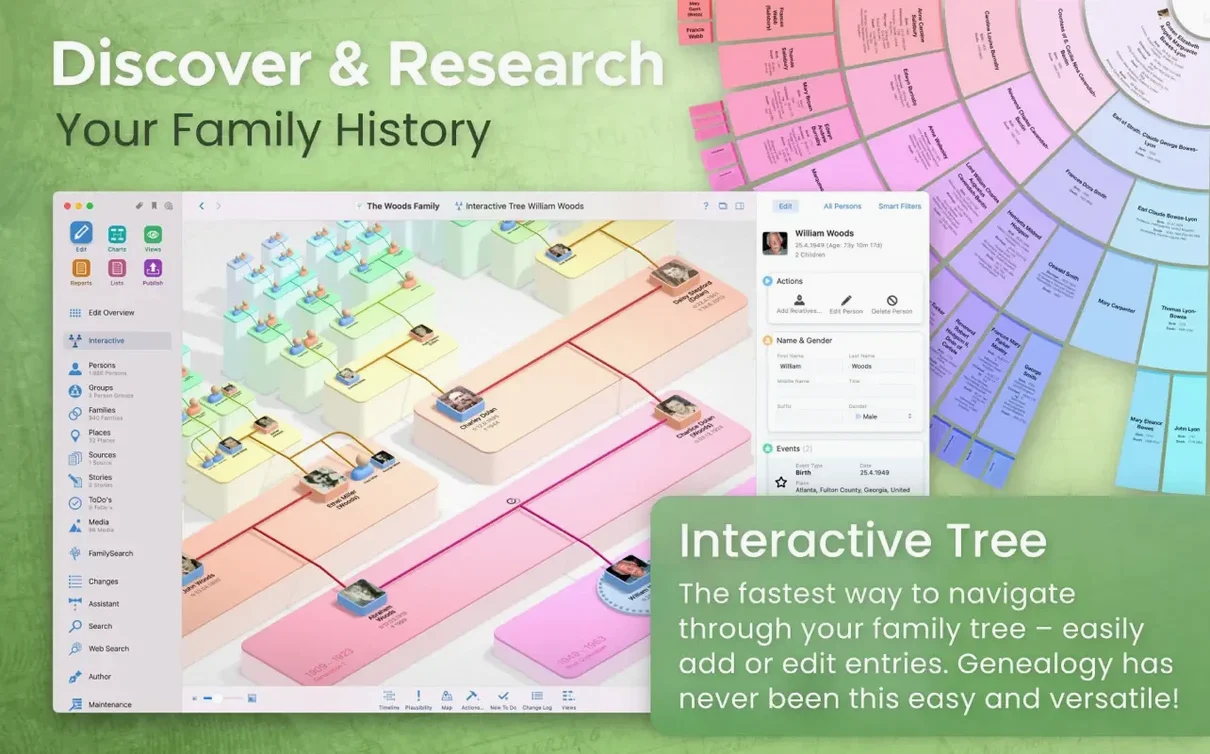
You sit down after Sunday lunch with a notebook full of names and dates from your aunt. MacFamilyTree is the Mac app that turns those scribbles into a clear family tree. Version 11.3.2 runs on macOS 12 Monterey or later and is optimized for Apple Silicon, so it feels quick on current Macs.
It fits well alongside your other tools. You can create interactive trees, switch to a virtual 3D view, and generate reports for narratives, maps, sources, and credibility. When you want to share progress, CloudTree Sync & Share handles real-time synchronization, and the companion MobileFamilyTree app for iPhone and iPad lets you add details on the go. If you prefer a printed record, the built-in diagrams, reports, and books cover that too.
The interface speaks seventeen languages, including English, German, Spanish, and Simplified Chinese, which helps when you collaborate with relatives abroad. You can even publish a family website through MacFamilyTree.com. For anyone already comfortable with Mac basics, this genealogy app fits naturally into a workflow that might otherwise rely on spreadsheets or paper. It is a straightforward way to keep family history organized and accessible.
How MacFamilyTree compares with similar apps
If you have looked at other genealogy software, you might know Gramps and Heredis. Gramps is free and open-source, which appeals to people who want no cost and plenty of customization. It is powerful but its interface feels dense, more like a database tool than a piece of Mac software. Heredis comes from a French developer and has strong support for European records, yet its Mac version sometimes lags behind the Windows one in updates and polish.
MacFamilyTree sits somewhere between them. It is not free like Gramps, but it is built specifically for Macs and takes advantage of macOS features that third-party ports often miss. The 3D tree view and CloudTree Sync & Share are features neither Gramps nor Heredis offer in the same way. If you value a clean interface and tight integration with iCloud and your other Apple devices, MacFamilyTree is the more natural choice.
Gramps handles GEDCOM import and export well, and so does MacFamilyTree, so moving data between apps is possible if you switch later. Heredis recently added its own sync system, but it requires their own cloud service, whereas MacFamilyTree uses your existing iCloud account, which many Mac users already have set up.
Enable iCloud syncing for MobileFamilyTree
When you first open MacFamilyTree, a few adjustments can make the experience smoother from the start. The app stores data locally by default, but if you plan to use the companion MobileFamilyTree app on your iPhone or iPad, enable iCloud sync right away. You find this in the preferences under Sync. Turning it on early ensures that records you add on your Mac appear on your mobile device without extra steps later.
Another setting to check is the language preference. MacFamilyTree supports seventeen languages, and the app matches your system language automatically. If you want to switch to a different one, for example to share a report with a relative who reads German or Spanish, change it in the General preferences. The interface updates immediately, and all your data remains intact.
Finally, if you plan to publish a family website through MacFamilyTree.com, set a password for it in the website preferences before you start. That way, you control who sees your family history from the beginning, and you can hide specific people or records from export if needed.
Export charts and reports to Pages and other apps
MacFamilyTree works well alongside the apps you already use. You can export charts and reports in multiple formats, which means you can drop a PDF of a family tree into a Pages document, or share a PNG of the hourglass chart in a Messages conversation. The narrative report, for example, reads well when printed or saved as a PDF and added to a family newsletter.
Because it stores data in iCloud, your family tree syncs automatically between your Mac, iPhone, and iPad through the companion MobileFamilyTree app. No manual transfers or emailing files. If you use macOS's built-in Time Machine for backups, your local MacFamilyTree data is included, so a hardware failure does not mean losing years of research.
You can also search FamilySearch records directly from inside the app. That saves you tabbing back and forth between a web browser and MacFamilyTree. The search panel pulls results into the app, and you can attach records to the right person without leaving the window.
Works on older Macs with macOS 12 Monterey or later
Will it work on my older Mac? MacFamilyTree 11 requires macOS 12 Monterey or later, so if your Mac runs Monterey, Ventura, Sonoma, or Sequoia, it will work. It supports both Intel and Apple Silicon Macs, and the developer says it is optimized for Apple Silicon. If you have a Mac from 2017 or later, it probably meets this requirement.
Do I need an iCloud account for syncing? Yes, if you want to sync between devices. The app stores data locally on your Mac, and that works fine on its own. But to share your tree with the companion MobileFamilyTree app on your iPhone or iPad, you need an iCloud account. Most Mac users already have one from setting up the computer.
Can I import data from another genealogy program? Yes. MacFamilyTree supports GEDCOM import and export, which is the standard format for family history data. You can bring in a GEDCOM file from Gramps, Heredis, Ancestry, or almost any other genealogy app. The import handles most fields, though you might need to check a few notes or sources afterward if the original app used a non-standard extension.
What happens if I stop using the app? Your data is stored in standard formats. You can export a GEDCOM file at any time and move to another program. The reports and charts you created remain as PDFs or images on your Mac. Nothing is locked in a proprietary format that holds your work hostage.
Is the website feature included? Yes, it is part of the app. You can publish a family website through MacFamilyTree.com directly from within MacFamilyTree. It is password-protected, so you control who sees it. The feature is there if you want it, but you do not have to use it.
- Stability improvements.
- macOS 12 Monterey or later
- Apple Silicon or Intel Mac
- iCloud account for syncing between devices
Questions I keep getting
Which macOS versions does MacFamilyTree 11 support?
MacFamilyTree 11 requires macOS 12 Monterey or later. It works on both Intel and Apple Silicon Macs, and is optimized for Apple Silicon.
How to install
- Open the downloaded disk image.
- Drag the app into the Applications folder alias.
- After copying finishes, launch the app from Launchpad.
Similar apps





Sign in or join the club to leave a comment.
Nobody has commented yet.