

- Version
- 1.37.5.2 fix
- Studio or maker
- Paradox Development Studio, Paradox Tinto
- Languages
- Russian, English, German, Spanish, French
- Activation
- Included
- Chip type
- Intel 64-bit
- Tried out on
- macOS Tahoe, Mac mini 2024 M4
- First released
- 13.08.2013
- Voice languages
- Music only
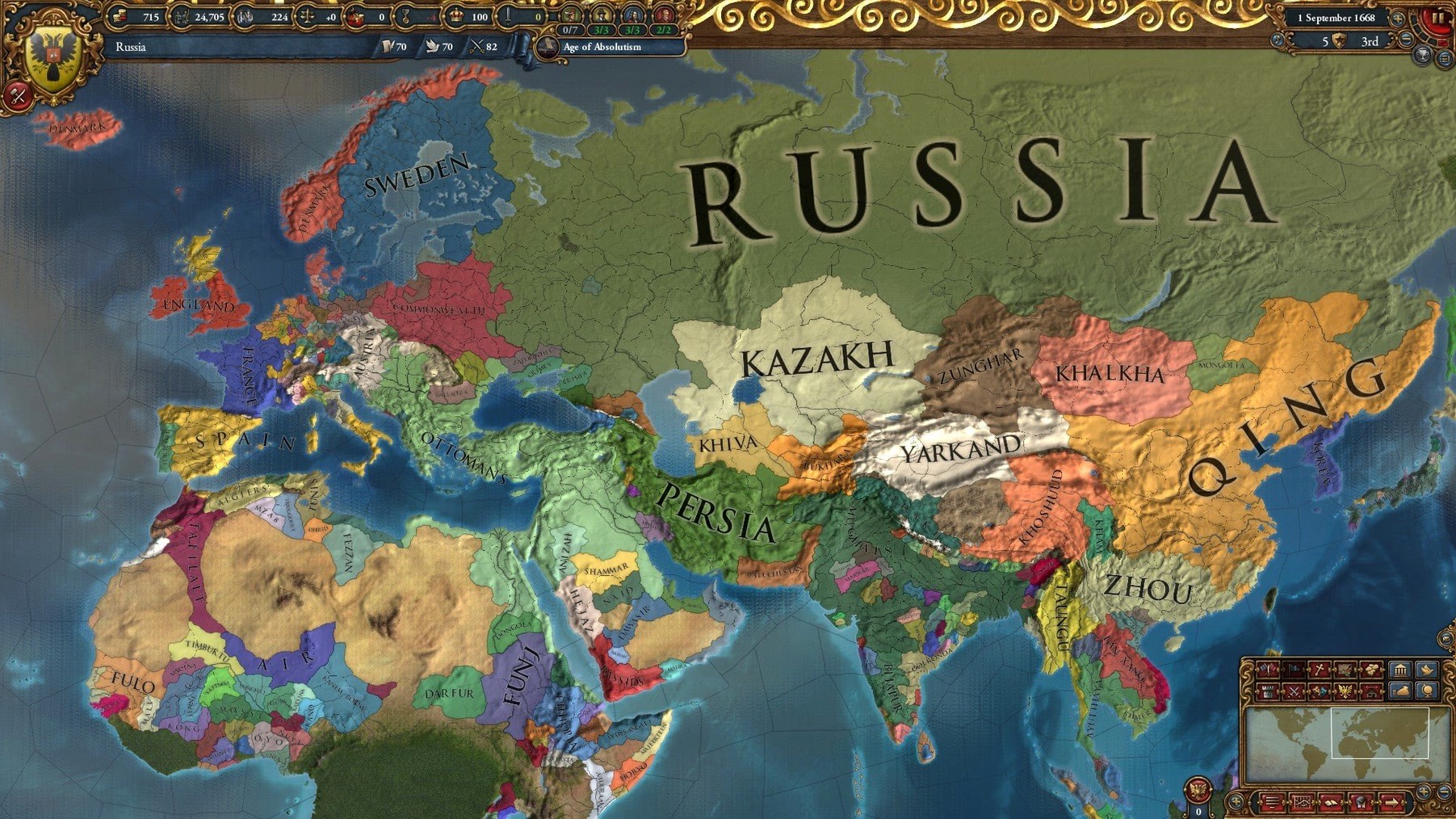
Europa Universalis IV runs on Intel Macs, so it will feel at home on older iMacs and MacBooks that newer games leave behind. The game itself is a grand strategy title from Paradox Development Studio and Paradox Tinto, released in 2013 and still going strong. You pick a nation in 1444 and guide it through four centuries of history, managing diplomacy, trade, war, and colonization until 1821.
The base game offers hundreds of nations and two play styles
The base game gives you the full campaign, with hundreds of nations to choose from. You can play tall, building up a small country, or go wide, conquering neighbors and rivals. The music sets the mood, and the interface is dense but learnable. Launch the game through the eu4 file, and you are in. It is a deep, patient game that rewards planning and a bit of stubbornness.
Europa Universalis IV rewards history buffs and strategy fans
Europa Universalis IV shines brightest for Mac users who already enjoy strategy games but want something with more depth than a typical real-time or turn-based title. History teachers, hobbyist historians, and anyone who likes reading about the early modern period will find the game a satisfying way to engage with the era. It also works well for players who prefer single-player experiences over multiplayer, because the AI is competent enough to keep you busy without needing a second person. If you are the sort of person who keeps a notebook next to the keyboard while playing a game, you are exactly the audience for this one.
On the hardware side, Intel Macs are the natural fit. If you have an older MacBook Air or a 2015 iMac that chokes on modern 3D titles, Europa Universalis IV runs on that architecture without fuss. The game does not demand a powerful GPU, so integrated graphics are fine.
Turn on tooltips from the main menu right after launching
When you first launch the game through the eu4 file, spend a few minutes in the main menu looking at the options screen. Turn on the tooltips — they are your best friend. The game is dense, and every button explains itself if you hover long enough. I recommend starting with a tutorial nation like the Ottomans or Portugal. They are forgiving: the Ottomans have a strong army and easy early targets, while Portugal lets you learn trade and colonization without constant land wars. Play the first fifty years twice, maybe with different small choices, to see how the game reacts. That is usually enough to understand the flow of peace, war, and diplomacy.
Another early habit worth building: pause often. Europa Universalis IV runs in real time, but it expects you to pause and think. Do not feel bad about hitting pause every few seconds in the first session. Eventually you will learn which events need immediate attention and which can wait while you speed up time. Also, save the game manually every ten or fifteen years in a separate slot. The autosave is reliable, but having a backup from a few decades back can save a campaign if you make a catastrophic diplomatic mistake.
Running out of administrative power from conquering too fast
New players often run into a few predictable problems. One is running out of administrative power early. Administrative power is the resource you use to core new provinces and unlock ideas. If you conquer too fast, your core creation costs pile up and your tech falls behind. The fix is simple: pause conquests and focus on developing your economy for a decade or two. Building marketplaces and workshops in high-value provinces helps generate income, which lets you hire better advisors.
Another common snag is the rebel problem. Rebels pop up when unrest is high, often because of religious or cultural differences after a war. Do not ignore them — they multiply. Check the stability tab every few years. If unrest is above zero in a province, consider increasing autonomy or sending a missionary if the religion differs. A small standing army of four or five regiments can handle most early rebellions before they grow out of control. If a full revolt breaks out, pause, gather your forces, and attack the rebel stack before it reaches your capital.
A third issue is trade. The trade system in Europa Universalis IV is not intuitive at first. Many new players collect trade in every node, which spreads their merchants too thin. Instead, send most of your merchants to steer trade toward your home node, and only collect in nodes you fully control. For example, if you play as England, steer trade from the English Channel node outward, and let your home node collect automatically. That single change often doubles your monthly income.
A Saturday afternoon as the Ottomans in 1478
Imagine it is a quiet Saturday afternoon. You open the game through the eu4 file, load your most recent save, and check the situation. You are playing as the Ottomans in 1478, about thirty years into the campaign. The first thing you do is pause and look at the diplomatic map mode. Your rival, the Mamluks, has grown stronger while you were dealing with rebels in the Balkans. Time to build up.
You unpause at normal speed and check your army maintenance slider. You also send your merchant in Alexandria to steer trade toward Constantinople instead of collecting there. The income graph goes up by two ducats a month.
Next, you look at your ruler's skills. Your current sultan has a 4 in administration but only a 2 in military. That hurts your army quality, so you hire a military advisor from the pool. Worth it for the coming war. You unpause and let a few months pass while you build up a war chest of around 500 ducats.
By late 1480, you declare war on the Mamluks with a claim on Syria. The first battles go well because you outnumber them two to one, but your siege on Jerusalem takes forever. That is normal — sieges in this era are slow. You keep a separate stack near the siege line to intercept any relieving army. After two years of war, you take Syria and a coastal province. You core the new land, raise autonomy in the more rebellious areas, and return to building your economy. The session ends after about three hours in-game, covering about fifteen years. You save, close the game, and already think about what to do next — maybe push into Persia or deal with the growing Venetian navy. That is the rhythm of Europa Universalis IV: slow, deliberate, and always pulling you forward.
- Architecture: Intel (x86 64-bit)
- macOS: not specified
How to install
- Run the standard installation procedure. This gets the game files onto your Mac.
- When setup finishes, choose where to install. Pick the Applications folder when prompted, so the game stays easy to find.
- Launch the game through the
eu4file. If you do not see it, openeu4.appand show theContents/MacOSfolder to locate theeu4file.
Similar games






Sign in or join the club to leave a comment.
Nobody has commented yet.